Fuel consumption calculator
Work out the consumption per 100 km from the distance and the fuel you put in, and below it the cost of any trip. For petrol, diesel and LPG, for electricity, and for CNG and hydrogen.
The calculator works with JavaScript on. Without it the formulas remain, and they give the same result.
Work out the consumptionWork out the energy consumption
Since the last full refuelling.In one stretch, with no charging on the way.
What it took to fill the tank now.The drop in battery level times its capacity: 44% of 60 kWh is 26.4 kWh.
ConsumptionEnergy consumption
Formula
fuel ÷ distance × 100energy ÷ distance × 100
Fuel and energy consumption · Formula
Fuel or energy ÷ distance × 100
- Petrol, diesel, LPG42.3 l ÷ 568 km × 100 = 7.4 l/100 km
- Electricity26.4 kWh ÷ 150 km × 100 = 17.6 kWh/100 km
- CNG, hydrogen15.6 kg ÷ 410 km × 100 = 3.80 kg/100 km
Trip cost
What does a trip cost?
Trip and fuelTrip and electricity
There and back? Type in twice the distance.
Your car’s average, or the result above, which comes here by itself.
Per litre, from the pump or the receipt.Per kWh, from the bill or the charger.Per kilogram, from the pump or the receipt.
Trip cost
- Fuel for the tripEnergy for the trip
- –lkWhkg
- Cost per km
- –
Formula
distance × consumption ÷ 100 × fuel pricedistance × consumption ÷ 100 × electricity price
Trip cost · Formula
Distance × consumption ÷ 100 × price
- Petrol, diesel, LPG300 km × 7.4 l/100 km ÷ 100 × €1.62/l = €35.96
- Electricity300 km × 17.6 kWh/100 km ÷ 100 × €0.32/kWh = €16.90
- CNG, hydrogen300 km × 3.80 kg/100 km ÷ 100 × €1.35/kg = €15.39
Measuring
Full to full: where the numbers come from
Fill the tank
Reset the trip meter, or note the odometer reading.
Drive as usual
The longer the stretch, the surer the result. One refuelling is one measurement.
Fill the tank again
The litres on the pump are the fuel you used, and the kilometres since the last refuelling are the distance.
A partial refuelling on the way? Add its litres to the fuel. Costmeter does that by itself.
Measuring
From the battery level: where the numbers come from
Note the battery level
Before you set off: the battery percentage and the odometer reading, or a reset trip meter.
Drive as usual
The longer the stretch, the surer the result. Do not charge on the way.
Read the drop
The drop in percent times the battery’s capacity is the energy used: 44% of 60 kWh makes 26.4 kWh.
A charger shows more, since it counts the charging losses. Costmeter works energy consumption out the same way: from the drop in battery level.
Measuring
Full to full: where the numbers come from
Fill the tank
Reset the trip meter, or note the odometer reading.
Drive as usual
The longer the stretch, the surer the result. One refuelling is one measurement.
Fill the tank again
The kilograms on the pump are the fuel you used, and the kilometres since the last refuelling are the distance.
A partial refuelling on the way? Add its kilograms to the fuel. Costmeter does that by itself.
This result is one measurement. Costmeter counts every one.
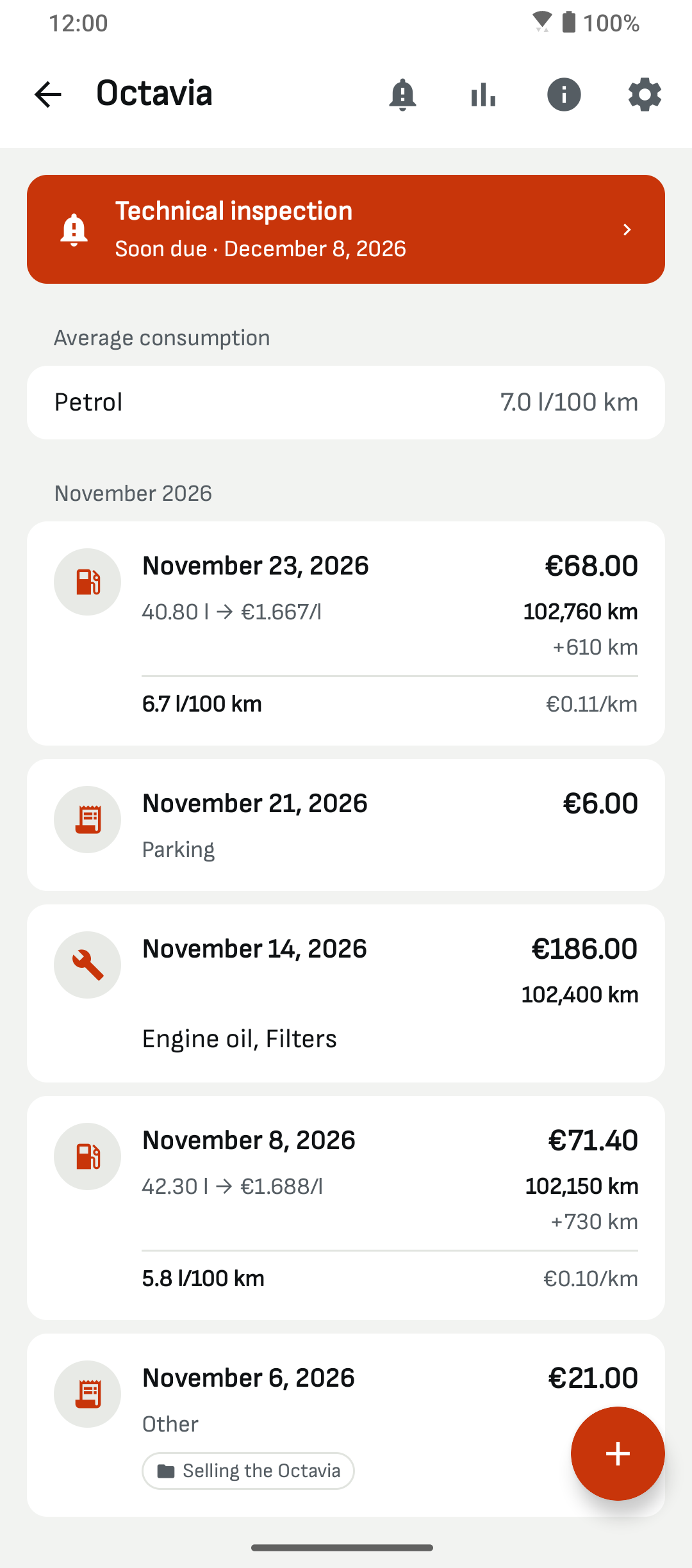
Log your refuellings and chargings in Costmeter, and the average consumption and the cost per kilometre work themselves out: over the whole history, for each car on its own.
Coming soon to Google Play